

JEE Main vs JEE Advanced:
Ultimate 2026-27 Guide with Books, Roadmap & Toppers Tips
Everything you need — detailed comparison, best books, step-by-step roadmap, toppers advice & comprehensive FAQs.
Table of Contents
JEE Main vs JEE Advanced: Complete Overview
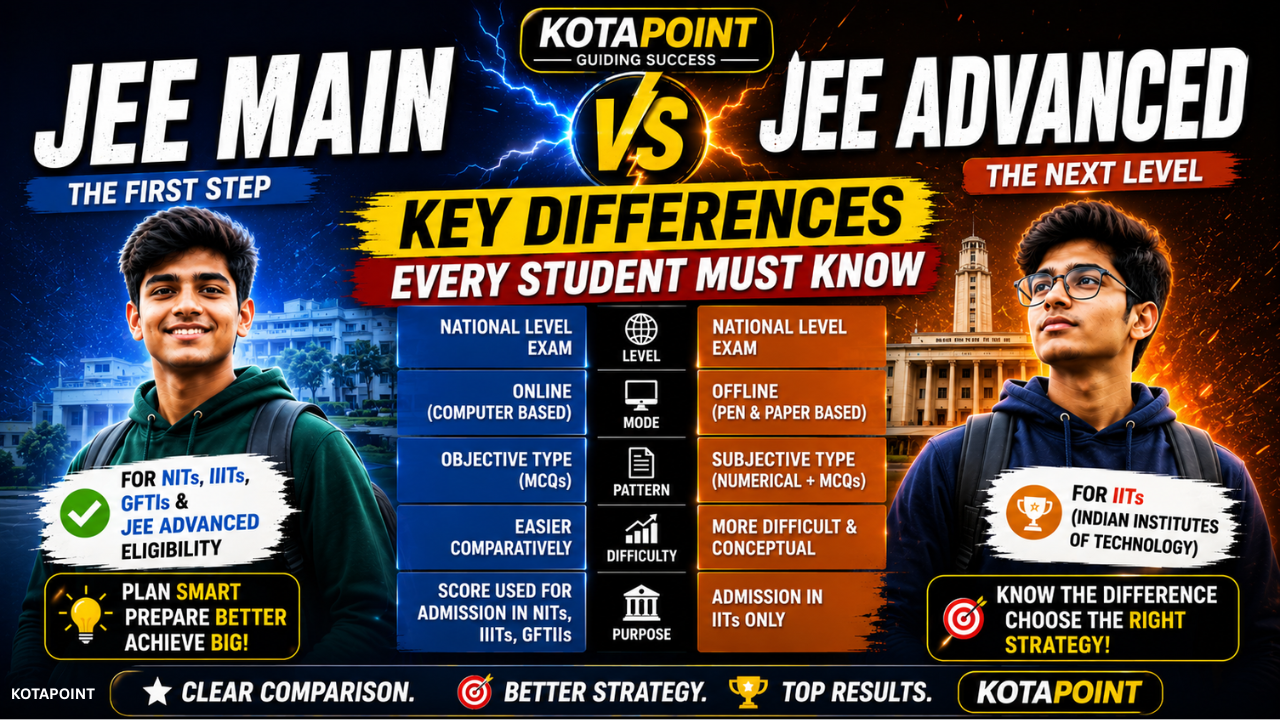
JEE Main, conducted by NTA twice a year, is the largest engineering entrance exam. It is the gateway to NITs, IIITs, GFTIs and qualifies students for JEE Advanced.
JEE Advanced, conducted by one of the IITs, is the final hurdle for admission into the 23 prestigious Indian Institutes of Technology (IITs). Only top ~2.5 lakh candidates from JEE Main are eligible.
Eligibility Criteria
JEE Main
- No age limit
- Class 12 with PCM
- 6 attempts (3 years)
- 75% for NIT/IIIT admission
JEE Advanced
- Top 2.5 lakh in JEE Main
- Born on/after Oct 1, 2001 (relaxation for reserved)
- Only 2 attempts
- 75% in Class 12 (65% for SC/ST)
Exam Pattern Comparison
| Parameter | JEE Main (Paper 1) | JEE Advanced |
|---|---|---|
| Frequency | Twice a year | Once a year |
| Duration | 3 hours | 6 hours (3+3) |
| Question Types | MCQ + Numerical | MCQ, Numerical, Matrix Match, Paragraph, Multi-correct |
| Total Marks | 300 | Varies (~360) |
| Difficulty | Moderate to High | Extremely High |
Syllabus Comparison
Topics Only in JEE Main
- • Electronic Devices
- • Communication Systems
- • Biomolecules, Polymers
- • Chemistry in Everyday Life
- • Mathematical Reasoning
Common Topics (Deeper in Advanced)
- • Mechanics & Electrodynamics
- • Organic & Physical Chemistry
- • Calculus & Coordinate Geometry
Advanced Specific Depth
- • Thermal Physics
- • Nuclear & Atomic Physics
- • Advanced Reaction Mechanisms
Which Exam is Tougher?
JEE Advanced is significantly tougher. It tests not just knowledge but deep conceptual understanding, application across topics, and performance under extreme time pressure.
Best Books for JEE Main & Advanced
JEE Main Focused
- Physics: HC Verma + DC Pandey
- Chemistry: NCERT + OP Tandon + MS Chauhan (Organic)
- Maths: RD Sharma + Cengage
JEE Advanced Focused
- Physics: HC Verma + Irodov + Krotov
- Chemistry: OP Tandon + Himanshu Pandey + JD Lee (Inorganic)
- Maths: SL Loney + GN Berman + Arihant Past Papers
12-Month Smart Preparation Roadmap
Foundation Building (Months 1-3)
Complete NCERT thoroughly. Focus on conceptual clarity and basic problem-solving.
Intermediate Level (Months 4-6)
Start reference books. Topic-wise tests. Identify and strengthen weak areas.
Advanced Problem Solving (Months 7-9)
Solve JEE Advanced level questions. Weekly full-length mocks.
Revision & Peak Performance (Months 10-12)
Intensive revision, PYQ analysis, and mock test marathon.
What Passout Students & Toppers Suggest
“NCERT is everything for JEE Main. For Advanced, master PYQs and solve Irodov religiously.”
“Daily consistent study of 7-8 focused hours beats 12+ hours of low productivity.”
“Class 11 syllabus carries more weight in JEE Advanced. Never neglect it.”
Frequently Asked Questions (FAQ)
1. Can I prepare for JEE Main and JEE Advanced simultaneously?
Yes. Most successful students follow an integrated approach — strong NCERT base for Main and gradually increasing difficulty for Advanced.
2. Is the syllabus completely different for JEE Advanced?
No. The core syllabus is almost the same, but JEE Advanced has a few extra topics and requires much deeper understanding and application.
3. How many attempts are allowed for each exam?
JEE Main: Up to 6 attempts (3 consecutive years × 2 sessions). JEE Advanced: Only 2 attempts in two consecutive years.
4. What is the age limit for JEE Advanced?
General category candidates must be born on or after October 1, 2001. 5 years relaxation for SC/ST/PwD candidates.
5. Which is more important — JEE Main or JEE Advanced?
Both are important. Strong performance in Main is necessary to qualify for Advanced. Your Advanced rank ultimately decides your IIT seat.
6. Can I crack JEE Advanced without coaching?
Absolutely yes. Many toppers crack it through self-study using quality books, previous year papers, and consistent mock tests.
7. How many hours should I study daily for JEE?
Quality matters more than quantity. 6-10 hours of highly focused study is ideal. Avoid burnout by taking short breaks.
8. How much does Class 11 syllabus matter in JEE Advanced?
Class 11 topics form around 40-50% of the paper. A strong foundation in Class 11 is crucial for success in Advanced.
9. What is the difference in question difficulty?
JEE Main questions are more direct and NCERT-based. Advanced questions are multi-concept, lengthy, and test analytical skills deeply.
10. Is there negative marking in both exams?
Yes. JEE Main has negative marking in MCQs. JEE Advanced has varying negative marking depending on the question type.
11. Should I drop a year if I don’t qualify for Advanced?
It depends on your overall performance and goals. Many students improve significantly in a drop year with better strategy.
12. What are the best resources for mock tests?
NTA official mocks, Allen, FIITJEE, Resonance, and previous year papers. Analyze every test thoroughly.
Ready to Begin Your JEE Journey?
Consistency + Smart Strategy = IIT / NIT Success
Explore More Free JEE Resources →