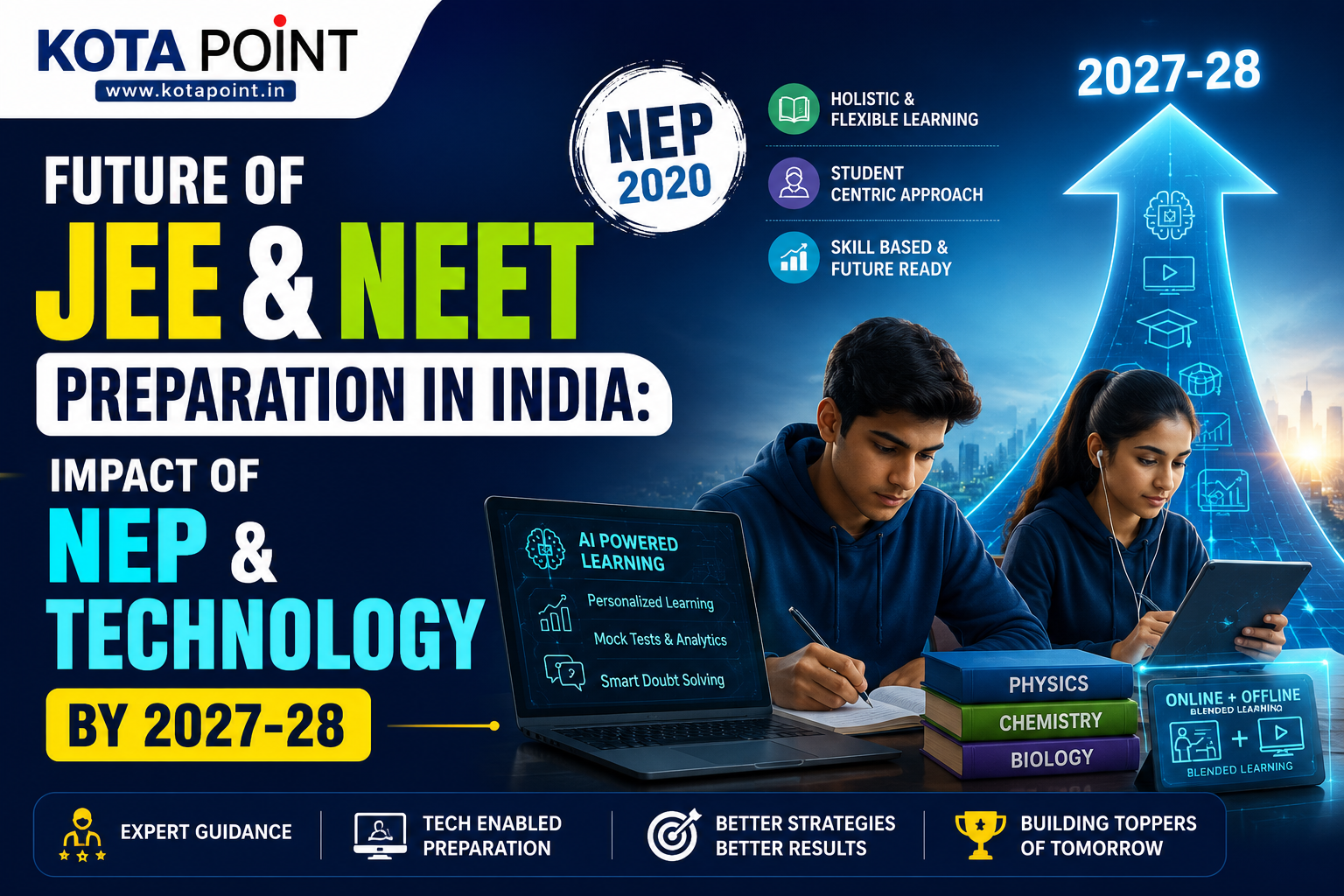

The landscape of JEE and NEET preparation in India is undergoing its biggest transformation in decades. With the full rollout of the National Education Policy (NEP) 2020 and rapid advancements in technology and AI, the way students prepare for these exams in 2027-28 will look significantly different from today.
At KotaPoint, we are closely tracking these changes to ensure our students stay ahead. This comprehensive guide explores what’s coming, how it will impact aspirants, and what you should do right now to prepare for success in JEE and NEET 2027-28.
NEP 2020: The Foundation of Future Education
The National Education Policy 2020 aims to move Indian education away from rote learning toward conceptual understanding, critical thinking, creativity, and multidisciplinary learning.
Key NEP-driven changes already visible or expected by 2027-28:
- Competency-based learning in schools (CBSE and many state boards)
- Board exams becoming more application-oriented with case-based and competency questions
- Introduction of skill-based and vocational subjects
- Possibility of two board exams in a year (already piloted)
- Greater emphasis on conceptual clarity over memorization
- Multidisciplinary approach — students can choose subjects more flexibly
These shifts directly influence JEE and NEET because both exams are gradually moving toward testing application of concepts rather than pure recall.
Major Expected Changes in JEE & NEET by 2027-28
| Area | Current Scenario (2026) | Expected by 2027-28 | Impact on Students |
|---|---|---|---|
| NEET Exam Mode | Pen & Paper (OMR) | Computer-Based Test (CBT) | Students must practice on computer |
| Question Style | Mix of direct + application | More case-based, competency & analytical | Deeper conceptual understanding needed |
| Board Exam Alignment | Moderate alignment | Stronger alignment with NEP competency focus | School studies will help competitive prep more |
| Attempts & Pressure | Single high-stakes attempt | Possibility of multiple attempts (discussions ongoing) | Reduced one-shot pressure |
| Technology Integration | Growing | AI-driven adaptive learning mainstream | Personalized preparation becomes essential |
| Hybrid Learning | Optional | New Normal | Best results from smart hybrid models |
Most Significant Change: NEET 2027 is expected to shift to Computer-Based Test (CBT) mode, as announced by the Education Ministry. This is a landmark reform aimed at improving transparency, security, and efficiency.
How Technology & AI Are Reshaping Preparation
Technology is no longer just an add-on — it is becoming the core of effective JEE and NEET preparation.
Key Technological Shifts by 2027-28:
- AI-Powered Personalized Learning
- Adaptive practice tests that identify weak areas in real time
- AI tutors for 24×7 doubt resolution
- Personalized study plans based on performance data
- Hybrid Learning Models (Online + Offline)
- Combination of live classroom teaching + recorded lectures + AI practice
- Students in smaller cities getting access to Kota-level faculty
- Advanced Analytics & Performance Tracking
- Detailed heatmaps of strengths and weaknesses
- Predictive analysis for rank improvement
- Immersive Learning (VR/AR)
- Better visualization of complex Physics and Chemistry concepts
- Computer-Based Test Practice
- Regular CBT mocks will become mandatory (especially for NEET 2027 aspirants)
Reality Check: While AI and technology will handle a large part of practice and personalization, human mentorship, peer competition, and structured guidance will remain irreplaceable for top ranks.
Hybrid Learning: The Winning Formula for 2027-28
By 2027-28, the most successful students will likely follow a smart hybrid approach:
- Core conceptual teaching through experienced faculty (offline or live online)
- Daily adaptive practice through AI-powered platforms
- Regular full-length CBT mocks with detailed analysis
- Personalized mentorship for strategy and doubt resolution
Pure offline Kota coaching will remain premium for serious aspirants, while high-quality hybrid and online programs will democratize access to quality education.
What Students & Parents Should Do Now (Action Plan for 2027-28)
| Class | Recommended Actions | Why It Matters |
|---|---|---|
| Class 9-10 | Build strong NCERT foundation + start light conceptual learning | NEP focuses on concepts from early classes |
| Class 11 | Join a good hybrid/integrated program + start regular testing | Most important year for building base |
| Class 12 + Dropper | Focus on CBT practice + AI tools + advanced problem solving | Direct preparation for new exam patterns |
| All Aspirants | Develop computer-based test comfort + work on time management & mental health | CBT mode + reduced rote learning pressure |
Pro Tips:
- Practice more case-based and application-oriented questions
- Get comfortable with computer-based testing early
- Use AI tools wisely for practice and revision (don’t over-rely)
- Maintain balance — NEP also emphasizes holistic development
How KotaPoint is Preparing Students for the Future
At KotaPoint, we are not just following these changes — we are actively building programs aligned with the future:
- Hybrid programs combining Kota’s best faculty with flexible online access
- AI-powered practice platforms and adaptive testing
- Regular Computer-Based Test series to prepare students for NEET 2027 CBT mode
- NEP-aligned teaching methodology focused on conceptual clarity + application
- Strong mentorship + mental well-being support
- Affordable options with scholarship support
We believe the future belongs to students who combine human guidance with smart technology.
Frequently Asked Questions (FAQ)
Q1. Will the JEE and NEET syllabus change significantly by 2027-28?
A: No major syllabus overhaul has been announced yet. Both exams are expected to continue being based on NCERT Class 11 and 12 concepts. However, the style of questions will become more application and competency-based.
Q2. Is NEET really going to become Computer-Based Test (CBT) from 2027?
A: Yes. The Education Ministry has confirmed the direction. NEET UG is expected to shift from pen-and-paper to CBT mode starting 2027 (gradual rollout considering the large number of candidates).
Q3. How will NEP 2020 affect JEE/NEET preparation?
A: NEP promotes conceptual understanding over rote learning. This means students who truly understand concepts (instead of memorizing) will have an advantage in both board exams and entrance tests.
Q4. Should I join hybrid coaching or stick to traditional offline for 2027?
A: A well-designed hybrid program is likely to give the best results for most students — combining quality teaching with flexibility and technology.
Q5. Will AI replace coaching institutes?
A: No. AI will become a powerful tool for practice and personalization, but human mentorship, structured learning, and peer environment will remain crucial for top ranks.
Q6. What is the biggest change students should prepare for right now?
A: Getting comfortable with Computer-Based Testing (especially for NEET aspirants) and shifting focus toward deeper conceptual understanding and application-based problem solving.
Q7. How can I stay updated about changes in JEE and NEET?
A: Follow official NTA and Education Ministry announcements. Reputed coaching institutes like KotaPoint also provide regular updates and guidance.
The Future is Bright for Prepared Students
By 2027-28, JEE and NEET preparation will be more conceptual, technology-driven, and student-centric. Students who adapt early — by focusing on understanding, practicing in CBT format, and using smart hybrid learning — will have a clear advantage.
The goal remains the same: cracking JEE or NEET and securing admission into top institutes. Only the path is evolving.
Ready to prepare for the future of JEE & NEET? Explore KotaPoint’s Hybrid & AI-integrated programs for 2027-28. Our expert mentors will help you build a personalized strategy aligned with NEP and upcoming technological changes.
Book a free counseling session today and stay ahead of the curve.
This analysis is based on current NEP 2020 implementation trends, official announcements, and industry insights as of June 2026. We will continue updating this page as new official notifications are released.