
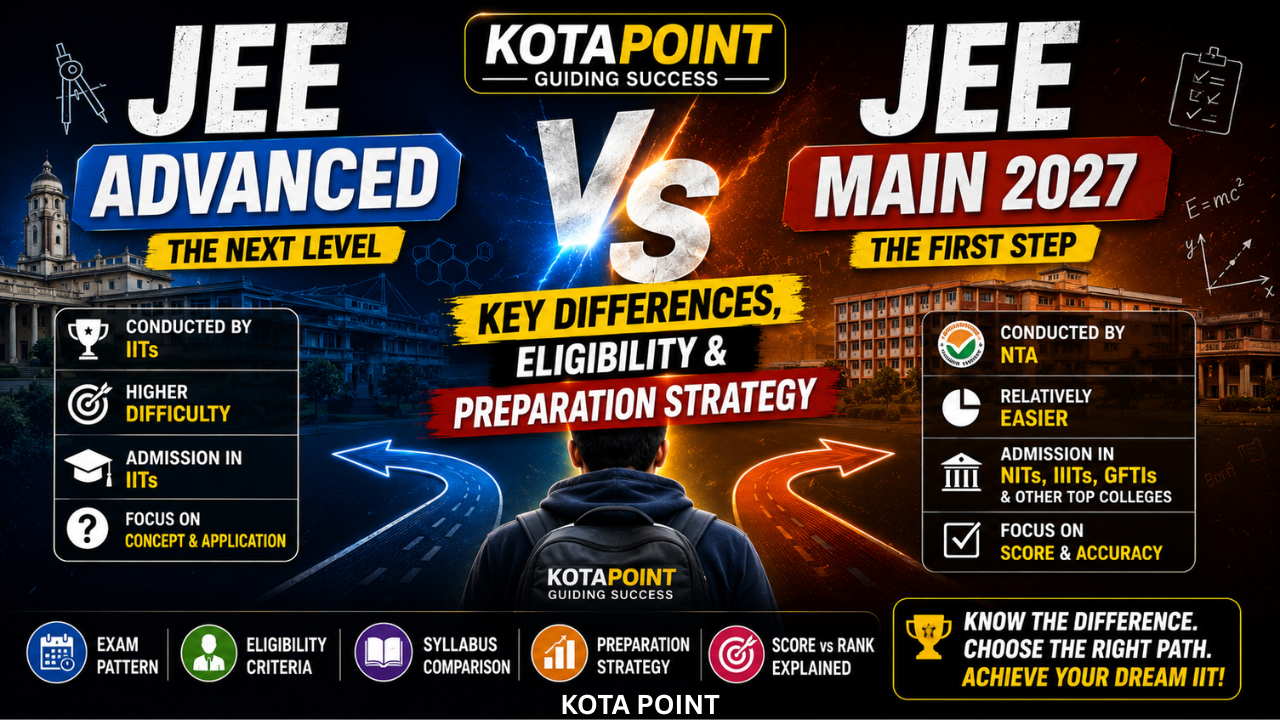

🎓Quick Overview — What Are JEE Main & JEE Advanced?
India’s engineering admission process has two distinct national entrance exams — JEE Main and JEE Advanced. While both test Physics, Chemistry and Mathematics at the Class 11–12 level, they differ dramatically in purpose, difficulty, question style, conducting body and the colleges they give access to.
- Conducted by NTA (National Testing Agency)
- Held twice a year — Session 1 (Jan) & Session 2 (Apr)
- Qualifies students for NITs, IIITs, GFTIs (~31,000 seats)
- Acts as the qualifying exam for JEE Advanced
- Top 2.5 lakh rankers are eligible for JEE Advanced
- CBT (Computer Based Test) mode
- Questions mostly test direct concepts and formulas
- Conducted by one of the 23 IITs on rotation
- Held once a year — typically May/June
- Qualifies students for 23 IITs (~17,500 seats)
- Considered one of the toughest entrance exams in the world
- Only those who qualify JEE Main can appear
- Two compulsory papers of 3 hours each
- Tests deep understanding, multi-step reasoning and application
📊Master Comparison Table — JEE Main vs JEE Advanced 2027
| Parameter | 🔵 JEE Main 2027 | 🟠 JEE Advanced 2027 |
|---|
📋Eligibility Criteria — Step by Step
- Class 12 or equivalent passed/appearing in 2026 or 2027
- Subjects: Physics, Chemistry, Mathematics & English mandatory
- No minimum marks in Class 12 to appear in JEE Main
- For NIT/IIIT admission: 75% in Class 12 (65% for SC/ST) or top 20 percentile in respective board
- Maximum 3 consecutive years of attempts (6 sessions)
- No age limit currently for JEE Main
- Must be among top 2.5 lakh in JEE Main 2027
- Class 12 for the first time in 2026 or 2027 only
- Maximum 2 attempts in consecutive years
- Should not have been admitted to any IIT previously
- Age: Born on or after October 1, 2002 (General); Oct 1, 1997 for SC/ST/PwD
- Class 12 with 75% marks (65% SC/ST) for final IIT admission
🗂️Exam Pattern — JEE Main vs JEE Advanced 2027
📖Syllabus Differences — What Extra Does JEE Advanced Test?
JEE Advanced broadly covers the same Class 11–12 NCERT syllabus as JEE Main, but goes significantly deeper in concept application and includes several additional topics not tested in JEE Main.
- Thermal conduction, convection & radiation in depth
- Newton’s law of cooling, Stefan-Boltzmann detailed
- Advanced wave optics — coherence, fringe width derivations
- Relativistic kinematics (some years)
- Detailed electromagnetic induction problems
- Advanced properties of matter — torsional oscillations
- Multi-concept problems combining 3–4 chapters
- Advanced Organic reaction mechanisms (arrow pushing)
- Rearrangement reactions in Organic Chemistry
- Advanced Electrochemistry & electrode kinetics
- Detailed Crystal Field Theory in Coordination
- Advanced Thermodynamics — Kirchhoff’s law, Born-Haber cycle in depth
- Nuclear chemistry in greater detail
- Detailed qualitative analysis and lab-based concepts
- Functional equations
- Advanced properties of definite integrals
- Detailed Differential Equations (higher order)
- Advanced 3D Geometry — skew lines, angle between planes
- Combinatorics — advanced counting & inclusion-exclusion
- Complex number applications at a higher level
- Graph theory basics (some years)
- Direct formula-based numerical questions
- Single-concept, straightforward MCQs
- Fact-based Chemistry (Inorganic memory questions)
- Standard integration/differentiation templates
- Standard Physics problems (kinematics, simple circuits)
- Speed and accuracy over depth
⚖️Difficulty Level Breakdown by Subject
🎯Expected Cutoff 2027 — JEE Main & JEE Advanced
Based on 2023–2025 trends, here are the expected cutoffs for both exams:
🔵 JEE Main 2027 — Cutoff to Qualify for JEE Advanced
| Category | JEE Main Cutoff (for Adv.) | NIT Admission Score | Top NIT (CSE) Score |
|---|---|---|---|
| General | ~85–92 marks | 93+ percentile | 99+ percentile |
| EWS | ~75–82 marks | 90+ percentile | 97+ percentile |
| OBC-NCL | ~68–75 marks | 88+ percentile | 96+ percentile |
| SC | ~48–55 marks | 82+ percentile | 93+ percentile |
| ST | ~40–48 marks | 78+ percentile | 91+ percentile |
| PwD | ~0.11 percentile | Varies | Varies |
🟠 JEE Advanced 2027 — Cutoff to Qualify for IIT Admission
| Category | Min Marks (Subject) | Min Aggregate | Top IIT (CSE) Rank |
|---|---|---|---|
| General | ~10% per subject | ~35% of total (~126/360) | AIR 1–300 |
| EWS | ~9% per subject | ~31.5% | AIR 300–1500 |
| OBC-NCL | ~9% per subject | ~31.5% | AIR 1000–4000 |
| SC | ~5% per subject | ~17.5% | AIR 1000–6000 |
| ST | ~5% per subject | ~17.5% | AIR 500–3000 |
| PwD | ~5% per subject | ~17.5% | Varies |
🏛️Colleges — NITs (JEE Main) vs IITs (JEE Advanced)
- 31 National Institutes of Technology (NITs) — NIT Trichy, NIT Warangal, NIT Surathkal, NIT Calicut, MNIT Jaipur, NIT Rourkela and more
- 26 Indian Institutes of Information Technology (IIITs) — IIIT Hyderabad, IIIT Allahabad, IIIT Delhi and others
- ~29 Government Funded Technical Institutes (GFTIs) — Delhi Technological University, IIEST Shibpur, etc.
- State Engineering Colleges using JEE Main scores in many states
- Many private engineering colleges using JEE Main percentile for merit-based admission
- IIT Bombay — India’s most prestigious engineering college for placement and research
- IIT Delhi — Top choice for CSE, Mathematics & Computing students
- IIT Madras — Consistently #1 in NIRF Engineering rankings
- IIT Kanpur, IIT Kharagpur, IIT Roorkee, IIT Guwahati — Older IITs with strong programs
- Newer IITs (Indore, Mandi, Tirupati, Dharwad, Bhilai, Goa, Jammu, Palakkad, Dharwad) offering growing programs
- ISM Dhanbad (IIT Dhanbad) — excellent for Mining, Petroleum Engineering
📚Best Books for JEE Main & JEE Advanced 2027
🧠Combined Preparation Strategy — Crack Both Exams Together
The smartest approach is to prepare for JEE Advanced as your primary goal — this automatically prepares you for JEE Main at the same time. Here’s the subject-wise strategy from Kota’s top coaching experts:
- Start with: HC Verma Vol. 1 & 2 — solve every exercise completely
- JEE Main: DC Pandey Objective Physics — all chapters
- JEE Advanced: DC Pandey Advanced Problems + Irodov (select problems)
- Focus chapters: Mechanics, Electrostatics, EMI & AC, Optics, Modern Physics
- Solve last 15 years JEE Advanced PYQs — concepts repeat even if questions don’t
- For speed (JEE Main): Practice 200+ numerical per chapter over your preparation
- Physical: NCERT + N. Avasthi (Physical Chem) — mole concept daily practice
- Organic: NCERT + MS Chauhan (elementary) → Morrison & Boyd for mechanisms
- Inorganic: NCERT line-by-line + VK Jaiswal; make reaction charts
- JEE Advanced Organic: Master arrow-pushing and rearrangement reactions
- Coordination Compounds: CFT, CFSE, isomerism — high weightage in both
- Make a reaction notebook: name reaction → reagent → product → conditions
- JEE Main: NCERT + Cengage Maths (all 6 volumes) — chapter by chapter
- JEE Advanced: Cengage + SL Loney (Trigonometry & Coordinate), Hall & Knight (Algebra)
- Priority topics: Calculus (40% of Maths), Vectors & 3D, Probability, Complex Numbers
- Calculus (Limits, Differentiation, Integration, Differential Equations) = most important topic across both exams
- Practice 20 integration problems daily — it’s a skill that compounds with practice
- For JEE Advanced: Solve Maths PYQs from 2005–2025 — many question styles repeat
- From Month 5 onwards: 1 JEE Main format mock per week (300 marks, 3 hrs)
- From Month 8 onwards: 1 JEE Advanced format mock per week (2 papers, 6 hrs)
- Spend equal time analyzing errors as appearing in the test
- JEE Advanced mocks: do not skip Paper 2 — many students are stronger in Paper 1 but Paper 2 can swing your rank by 3,000+ positions
- Track your weak chapters in a log — revisit weekly
- In final 2 months: 3 mocks per week, focused revision between mocks