
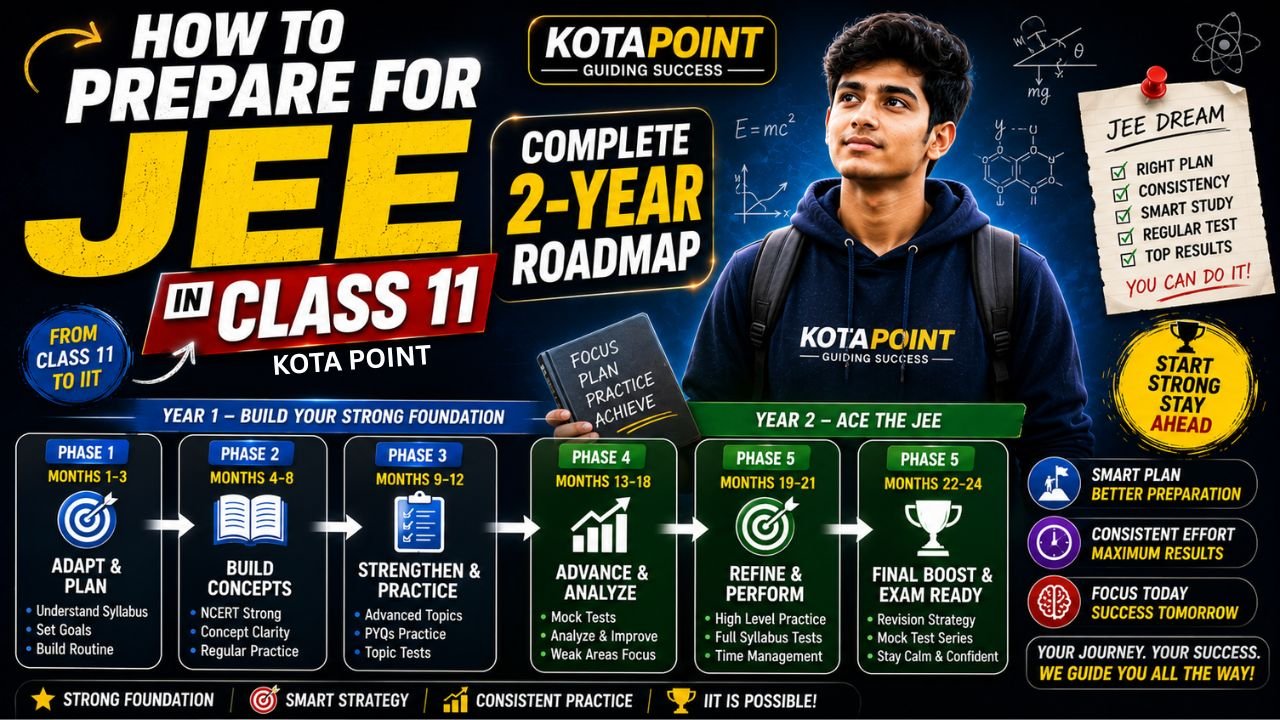
How to prepare for jee class 11

How to Prepare for JEE in Class 11 – Complete 2-Year Roadmap

How to Prepare for JEE in Class 11 – Complete 2-Year Roadmap | KotaPoint
JEE
JEE Preparation

How to Prepare for JEE in Class 11
– Complete 2-Year Roadmap

KP
KotaPoint Editorial Team
Ex-IITians & JEE Educators
📅 June 10, 2025 ⏱ 20 min read 👁 48,230 views
⚡ What You’ll Learn in This Guide
  • Why Class 11 is the most critical year for JEE
  • Month-by-month study plan for 2 years
  • Subject-wise strategy for Physics, Chemistry & Maths
  • Best books recommended by Kota toppers
  • Daily timetable with time slots
  • How to crack mock tests & analyse mistakes
  • Common mistakes that ruin 90-percentilers
  • Mental health & burnout prevention tips

Class 11 is the most underrated year in any JEE aspirant’s journey. Most students treat it casually — copying notes, attending school half-heartedly — and then panic in Class 12. The students who crack JEE Advanced in their first attempt with top ranks almost always built their foundation in Class 11.

This isn’t just another article. This is a battle-tested 2-year roadmap used by thousands of students from Kota who’ve cleared JEE Main with 99+ percentile and JEE Advanced under AIR 500. Follow it precisely and you’ll be miles ahead.

“JEE is not won in Class 12. It is won or lost in Class 11.” — A Kota veteran faculty member with 20+ years of experience

📊 JEE by the Numbers — Know What You’re Getting Into

Before diving into the roadmap, understand the scale of the competition. This isn’t to scare you — it’s to help you plan realistically.

13L+
Students appear for JEE Main every year
1.8L
Qualify for JEE Advanced
~48K
Get IIT seats (all categories)
~17K
General category IIT seats

The competition is intense, but it’s absolutely winnable with a clear plan started from Class 11. Most students don’t have a structured roadmap — that’s your biggest competitive advantage.

📌
Who Is This Guide For?

Students entering or currently in Class 11 who aim for JEE Main (95–99.9 percentile) and JEE Advanced. Also useful if you’ve just started Class 12 and need to catch up.


🏗️ Why Class 11 Is the Real Foundation

Here is a fact most students discover too late: nearly 45–50% of JEE Advanced and 40–45% of JEE Main questions come from Class 11 topics. If you rush through Class 11 or treat it as “just school,” here’s what gets affected:

  • Physics: Mechanics (Kinematics, Laws of Motion, Rotational Motion) is the backbone of nearly every complex JEE Physics problem. Electrostatics and Current Electricity in Class 12 heavily depend on it.
  • Chemistry: Organic Chemistry’s fundamentals — nomenclature, GOC, basic reactions — are Class 11 topics. Without them, Class 12 Organic is a nightmare.
  • Maths: Trigonometry, Coordinate Geometry, and Quadratic Equations from Class 11 appear in almost every JEE Maths paper directly or as tools to solve harder problems.
❌ What Most Students Do

Rush through Class 11, memorise formulas, skip hard problems, wait for Class 12 to “get serious.” Result: weak foundation, 85–90 percentile ceiling.

✅ What Toppers Do

Treat Class 11 like it IS the JEE. Build concept clarity, solve problems daily, revise weekly. Result: 99+ percentile because the foundation is unshakeable.


🗓️ The Complete 2-Year Phase-Wise Roadmap

The 2-year JEE journey is divided into 5 clear phases. Each phase has a specific goal and set of activities. Don’t jump phases — they are sequenced for a reason.

P
1
April – July (Class 11) · 4 Months
Foundation & Concept Building
Master NCERT line by line. Build strong fundamentals in all three subjects simultaneously. No shortcuts, no skipping chapters. Complete Class 11 basics by July end. Start solving NCERT examples and exercises fully.
P
2
August – December (Class 11) · 5 Months
Concept Deepening + First Mock Tests
Move to advanced reference books (HC Verma, MS Chauhan, Arihant). Solve chapter-wise JEE PYQs from 2005–2024. Give your first chapter-wise tests in September and first full-length mocks in November.
P
3
January – May (Class 12) · 5 Months
Class 12 Syllabus + Parallel Revision
Cover Class 12 high-weightage topics (Electrostatics, Electrochemistry, Integration, Optics) while weekly revising Class 11. Board prep runs in parallel — it reinforces JEE concepts, not distracts.
P
4
June – September (Class 12) · 4 Months
Full-Length Mocks + Error Analysis
Minimum 2 full mocks every week. Spend equal time analysing as attempting. Maintain an error log. Focus revision on weak chapters identified from mocks. Speed + accuracy drills.
P
5
October – January (Class 12) · 4 Months
Final Revision + JEE Main + Advanced Prep
Minimum 3 complete revision cycles of the full syllabus. Appear in JEE Main January session, use results to fix gaps, prepare intensively for Advanced. Daily 2–3 Advanced-level problems in each subject.

📅 Month-by-Month Study Plan — Class 11

This is your chapter roadmap for Class 11. The sequence is optimised so that topics in each subject complement each other and concepts build progressively.

MonthPhysicsChemistryMathematics
April–May
Foundation
Units & Dimensions, Kinematics (1D & 2D) Some Basic Concepts, Mole Concept, Atomic Structure Sets, Relations & Functions, Basic Algebra review
June Laws of Motion, Friction, Circular Motion Periodic Table, Chemical Bonding & MOT Trigonometric Functions (all identities + equations)
July Work, Energy & Power, System of Particles States of Matter: Gases & Liquids, Thermodynamics Principle of Mathematical Induction, Complex Numbers
August Rotational Motion, Gravitation Equilibrium (Ionic + Chemical), Redox Reactions Linear Inequalities, Permutation & Combination, Binomial Theorem
September Properties of Bulk Matter, Thermal Properties Hydrogen, s-Block Elements, p-Block Part 1 Sequences & Series, Straight Lines, Conic Sections (Parabola)
October Oscillations (SHM), Waves Organic Chemistry: Basic Principles & Techniques, GOC Conic Sections (Ellipse, Hyperbola), 3D Intro, Limits & Continuity
November
First Full Mock
Revision + Chapter-wise PYQs Hydrocarbons (Alkane, Alkene, Alkyne, Aromatic) Differentiation (basics), Statistics, Probability
Dec–Mar
Deep Practice
Full Class 11 revision + Advanced level problems Environmental Chemistry, Full Organic revision, PYQs Application of Derivatives, indefinite Integration basics
⚠️
Don’t Move On Too Fast

Don’t proceed to the next chapter until you can solve at least 65–70% of JEE-level problems from the current one. Rushing ahead with weak chapters is the #1 reason students plateau at 90 percentile despite working hard.


🎯 Subject-Wise Strategy in Detail

JEE tests depth, not breadth. Each subject demands a completely different approach. Here’s exactly how to tackle each one:

⚛️Physics
  • NCERT first, then HC Verma — in that order
  • Mechanics is your highest-priority chapter
  • Always draw diagrams before solving
  • DC Pandey for variety + difficulty
  • Weekly formula sheet revision
  • Conceptual questions over formula rote
🧪Chemistry
  • NCERT is gold — read every line 3 times
  • Organic: understand mechanisms, not by-heart
  • Physical Chem: solve like Maths problems
  • Inorganic: make daily flash-card notes
  • JD Lee for Inorganic depth (selective reading)
  • Never skip NCERT examples
📐Mathematics
  • Master Coordinate Geometry first
  • Consistency beats speed — daily problems
  • Arihant Skills in Maths series (chapter-wise)
  • Attempt variety — not just easy sums
  • 10–15 problems minimum per day
  • Show all working — no mental shortcuts early

Physics: Roadmap Inside the Roadmap

Physics has a clear hierarchy. Master in this order: Mechanics → Electrostatics & Magnetism → Optics → Modern Physics → Heat & Waves. Mechanics is the foundation for everything — spend extra time here in Class 11 and it will pay dividends in Class 12 topics.

Chemistry: The Three-Track Approach

Treat the three branches separately. Physical Chemistry is essentially applied Maths — solve daily. Organic Chemistry needs you to think like a mechanism storyteller — follow the electron, understand why reactions happen. Inorganic Chemistry is memory-heavy — small daily doses work better than marathon sessions.

Mathematics: Where Ranks Are Made

Maths is the great differentiator in JEE Advanced. Students who excel at Maths almost always end up in top 500 AIR. Key: solve problems from multiple angles. When you solve a Coordinate Geometry problem, also think of the Calculus-based approach. This multi-approach thinking is exactly what Advanced Maths tests.


⏰ Ideal Daily Timetable for Class 11 JEE Aspirant

Your schedule matters more than your intelligence. Here’s a battle-tested daily routine that balances school, coaching, self-study, and rest without burning out:

TimeActivitySubject
5:30 – 6:30 AMWake up + Quick revision of yesterday’s notesRevision
6:30 – 7:15 AMFreshen up, Breakfast, Travel prepBreak
7:15 AM – 2:00 PMSchool / Coaching — attend actively, take notesSchool/Coaching
2:00 – 3:00 PMLunch + Rest (mandatory — 45 min max nap)Rest
3:00 – 5:30 PMSelf-study Block 1 — solve today’s chapter problemsPhysics / Maths
5:30 – 6:00 PMShort break — walk, snack, zero screensBreak
6:00 – 8:30 PMSelf-study Block 2 — weak chapters or PYQsChemistry / Revision
8:30 – 9:15 PMDinner + Family timeBreak
9:15 – 11:00 PMSelf-study Block 3 — formula sheets, NCERT Inorganic, theory consolidationAll Subjects
11:00 – 11:15 PMDaily review: 3 things learned, doubts flagged, tomorrow’s planPlanning
SundayFull mock test (morning) + Full paper analysis (afternoon)Mock Test
Sleep Is Not Optional

Get 6.5–7.5 hours of sleep every night. Sleep-deprived studying has been shown to reduce retention by up to 40%. Toppers sleep well — it’s not a myth. Your brain consolidates memories during sleep.


📚 Best Books for JEE Preparation (Kota Topper List)

The golden rule: finish fewer books deeply rather than start many shallowly. One book read 3 times is worth more than three books read once.

Physics

Concepts of Physics Vol 1 & 2
H.C. Verma
Must Have — The JEE Bible for Physics. Best for concept clarity and medium-hard problems.
Problems in General Physics
I.E. Irodov
Advanced — For AIR <500 aspirants only. Solve selectively after HC Verma.
DC Pandey Series
DC Pandey / Arihant
Must Have — Great variety and JEE-level problems chapter-wise.
NCERT Physics XI & XII
NCERT
Must Have — Don’t skip. Modern Physics NCERT is especially important for JEE Main.

Chemistry

NCERT Chemistry XI & XII
NCERT
Must Have — Especially for Inorganic. Read every word including examples.
Organic Chemistry (Problems)
M.S. Chauhan
Must Have — Best Organic Chemistry problem book for JEE. Start after NCERT.
Concise Inorganic Chemistry
J.D. Lee
Advanced — Selective chapters only (transition metals, coordination compounds) for Advanced.
Physical Chemistry
N. Avasthi / P. Bahadur
Must Have — Numerical practice for Physical Chem. Pick one and stick to it.

Mathematics

Skills in Mathematics Series
Arihant / S.K. Goyal, R.D. Sharma (JEE)
Must Have — Chapter-wise books. Best for JEE Maths concept + problem coverage.
Problems in Calculus of One Variable
I.A. Maron
Advanced — For Calculus depth. AIR <1000 aspirants benefit the most.
Coordinate Geometry
S.L. Loney
Advanced — Classic book for Coordinate Geometry. Selectively use Part 1.
Trigonometry & Heights-Distances
S.L. Loney
Advanced — For comprehensive Trigonometry coverage beyond NCERT.

📝 Mock Test Strategy — How Toppers Use Tests Differently

Most students give mock tests and move on. Toppers treat each mock test as a goldmine of information. Here’s the difference:

1
Start Chapter Tests Immediately

After finishing each chapter, give a 25–30 question chapter test within 48 hours. Don’t wait for “full syllabus.” Early testing identifies gaps when they’re easier to fix.

2
First Full Mock: November of Class 11

Give your first full-length mock test in November even if you haven’t completed the full syllabus. The experience of managing 3 hours is itself a skill that needs months to develop.

3
The 3-Category Error Log

After every mock, categorise every wrong answer as: (A) Silly mistake/calculation error, (B) Concept misunderstood, (C) Topic never studied. Each category needs a different fix — don’t treat them the same.

4
Re-attempt Wrong Questions After 48 Hours

Without looking at solutions, re-attempt every wrong question 2 days after the mock. If you still can’t solve it, THEN look at the solution. This builds genuine understanding, not solution-dependence.

5
Track Your Time Distribution

Use a watch during mocks. Note how many minutes you spent per section. If you’re spending 90 minutes on Physics, you’re leaving Maths under-attempted. Adjust your section order strategy accordingly.

6
Mock Test Frequency Target

Class 11: 1 mock/month (Nov–Mar). Class 12 (June–Nov): 2 full mocks per week. In final 2 months before JEE Main: daily mocks if possible. Many AIR <100 holders gave 60–80+ full-length tests.


🔄 Transitioning to Class 12 Without Losing Momentum

The Class 11 → Class 12 jump is where most aspirants stumble badly. New chapters pile up, board exam pressure kicks in, and Class 11 concepts start fading. Here’s how to manage this transition smoothly:

The Weekly Revision Rule

Allocate 45 minutes per subject per week specifically for Class 11 revision. This is non-negotiable. It takes just 2.25 hours per week to keep 2 years of Class 11 concepts fresh — a tiny investment for massive returns in the exam.

Boards and JEE: Not Enemies

Over 75–80% of boards syllabus directly overlaps with JEE Main. Studying for boards is studying for JEE — if you do it right. The only “extra” in boards is essay-type answers and some topics dropped from JEE. Don’t treat them as separate preparations.

Class 12 Priority Topics for JEE

SubjectHighest Priority for JEEDon’t Neglect
PhysicsElectrostatics, Current Electricity, Electromagnetic InductionOptics, Modern Physics, Semiconductors
ChemistryElectrochemistry, Chemical Kinetics, Coordination CompoundsSolid State, Solutions, Polymers
MathsDefinite Integration, Differential Equations, Vectors & 3DProbability, Matrices & Determinants, Linear Programming

🚫 Top 10 Mistakes That Kill JEE Ranks

After analysing thousands of students’ JEE journeys in Kota, here are the most common mistakes that separate 85-percentilers from 99-percentilers:

1
Passive Reading Without Solving

Reading theory and highlighting textbooks feels productive but is nearly useless without active problem solving. Immediately after reading a concept, close the book and solve 5 problems.

2
Too Many YouTube Videos, Too Little Practice

Video lectures are a supplement, not the main course. 1 hour of video should be followed by 2 hours of solving problems based on what was watched.

3
Skipping NCERT for “Better” Books

NCERT is the base. In JEE Main 2024, several questions could ONLY be solved directly from NCERT text. Skip it and you’re leaving easy marks on the table.

4
Not Maintaining an Error Log

Repeating the same mistakes in successive mocks is one of the biggest score killers. An error log forces you to confront and fix your recurring blind spots.

5
Studying Without a Specific Goal Per Session

“Study Physics for 2 hours” is vague and leads to low-efficiency browsing. “Solve 20 Kinematics problems, including 5 from 2020–2024 PYQs” is specific and measurable.

6
Ignoring Weak Subjects Until Too Late

Most students avoid their weakest subject and double down on their strongest. JEE tests all three. A 60 percentile in Chemistry kills your overall rank no matter how good Physics is.

7
Neglecting Revision Cycles

New learning without revision is like filling a bucket with holes. Schedule one complete revision cycle per month in Class 12. By exam time, you should have completed at least 3 full revisions.

8
Changing Strategy Too Frequently

Changing study books, routines, or approach every few weeks based on YouTube advice is a disaster. Pick your strategy, execute for 3 months, then evaluate. Consistency beats perfection.

9
Comparing Progress With Classmates

Your JEE journey is individual. Someone else being “ahead” in syllabus doesn’t mean you’re behind. Focus on your own concept clarity, not coverage comparison.

10
Burning Out By Ignoring Mental Health

2-year JEE prep is a marathon. Students who ignore rest, hobbies, and social connections peak early and crash before the exam. Sustainable rhythm beats extreme sprints.


🧠 Mental Health, Motivation & Avoiding Burnout

This section gets skipped in most JEE guides. But experienced Kota educators consistently say that mental state determines rank as much as study hours. Here’s how to stay mentally strong through 2 years of intense preparation:

💡
The Reality of JEE Preparation

There will be weeks when nothing clicks, mocks go badly, and you question everything. This is completely normal — every topper has gone through this. It’s a temporary valley, not a dead end. Your job is just to keep showing up.

Practical Mental Health Habits

  • Take one full off day per month — completely away from studies. Recharging is productive.
  • 30 minutes of physical activity daily — walking, sports, anything. Exercise directly improves memory consolidation and focus.
  • Talk to someone when overwhelmed — parents, a trusted friend, a mentor. Bottling up stress destroys performance more than taking an hour off.
  • Celebrate small wins — finished a chapter? Solved a hard problem? Acknowledge it. Motivation comes from tracking progress, not just goals.
  • Limit social media to 20 minutes/day — not zero, but contained. Total deprivation creates binging, partial restriction is sustainable.
  • Maintain one non-JEE hobby — music, sketching, cooking. It keeps your identity broader than “JEE student” and reduces burnout.
“The students who crack JEE Advanced aren’t the ones who studied 16 hours every day. They’re the ones who studied 8–10 quality hours consistently for 2 years.” — IIT Bombay alumnus & Kota faculty

🗂️ Previous Year Questions (PYQ) Strategy

JEE PYQs from 2010–2024 are the single most valuable resource you have. Here’s how to use them strategically, not just as extra problems:

When to Start PYQs?

Start chapter-wise PYQs immediately after finishing each chapter, even in Class 11. Don’t wait until Class 12 to “do PYQs.” Every JEE Main and Advanced PYQ from 2015–2024 is available free online.

How to Analyse PYQs

  • Note which concepts repeat most across years — these are your high-priority topics
  • Observe the difficulty trend — JEE Advanced has gotten harder since 2017; JEE Main question types have evolved
  • Identify question types you consistently struggle with — solve similar problems until they become easy
  • Time yourself on PYQ sets — simulate actual exam pressure
PYQ Coverage Target

By the time you sit for JEE Main, you should have solved every JEE Main PYQ from 2016–2024 (all sessions) at least once, and every JEE Advanced PYQ from 2013–2024 at least once. That’s approximately 3000–4000 questions — very doable over 2 years.


❓ Frequently Asked Questions

Can I crack JEE without going to Kota or a coaching institute?
Absolutely — many top rankers have cracked JEE through self-study or local coaching. What matters is resource quality and consistency of practice. KotaPoint provides free study material, test series, and guidance so you can prepare from anywhere in India. Coaching helps with structure and doubt-clearing, but it’s not a prerequisite for success.
How many hours should I study daily in Class 11?
Aim for 6–8 hours of focused self-study per day outside school/coaching in Class 11. Quality beats quantity — 6 hours of focused study outperforms 12 hours of distracted browsing. Increase to 8–10 hours in Class 12. Never sacrifice sleep for extra hours — sleep-deprived studying is counterproductive.
What if I’m already mid-way through Class 11 and haven’t started JEE prep?
Don’t panic — it’s recoverable. Start immediately and prioritise high-weightage topics: Mechanics (Physics), Mole Concept & Organic basics (Chemistry), Trigonometry & Coordinate Geometry (Maths). Compress Phase 1 but don’t skip concepts. Many students have cracked JEE starting serious prep in October or November of Class 11.
Should I focus more on JEE Main or JEE Advanced from Class 11?
Focus on JEE Advanced from the start. Advanced preparation covers everything in Main and more. If you prepare for Advanced, Main becomes relatively easier. The mistake is preparing only for Main and then scrambling to add Advanced-level depth in 2 months — it doesn’t work.
Is NCERT enough for JEE Chemistry?
For Inorganic Chemistry, NCERT is nearly sufficient for JEE Main and forms the base for Advanced. For Organic, you need extensive problem practice beyond NCERT (MS Chauhan is the go-to). For Physical Chemistry, treat it purely as a Maths problem-solving exercise and use a dedicated problem book like N. Avasthi.
How do I handle low mock test scores without losing motivation?
Remember: a low mock score early is information, not failure. Every mock test you give and analyse makes you better — regardless of the score. The trajectory matters more than any single data point. Track your error log and watch specific mistake categories shrink over weeks. That progress is real even when overall scores fluctuate.
Dropper vs first-attempt: does it matter?
Many IIT toppers are droppers, and many crack it on first attempt. The year itself doesn’t determine success — your preparation quality does. If you’re a dropper, you have the advantage of knowing the exam pattern and your weak spots. Use that advantage systematically and you’ll perform better than your first attempt.

🏁 Final Words: Your JEE Journey Starts Now

You now have a complete, honest, and detailed 2-year roadmap to crack JEE from Class 11. Let’s summarise the non-negotiables:

The 7 Pillars of JEE Success from Class 11

1. NCERT mastery before anything else. 2. Daily problem solving — no passive studying. 3. Weekly revision — never let a chapter fully fade. 4. Chapter-wise testing from Day 1. 5. Error log maintenance after every test. 6. Consistent 6–8 hour daily schedule without extreme days. 7. Protecting mental health as seriously as protecting study hours.

The students sitting in IITs right now weren’t smarter than you when they started Class 11. They were more consistent, more systematic, and more patient. That’s entirely within your control.

Start today. Not Monday, not next month — today. Even 30 minutes of focused NCERT reading right now puts you ahead of where you were this morning.

KP
KotaPoint Editorial Team
JEE Experts · Ex-IITians · Kota Educators

Our editorial team comprises IIT alumni and JEE educators with a combined 50+ years of experience in Kota coaching. We’ve helped over 1 lakh students navigate their JEE journey through honest, research-backed guidance.

Ready to Start Your JEE Journey?

Download free chapter-wise notes, PYQ collections, and full mock tests — curated by Kota’s top educators. Completely free.

← Previous Post
JEE Main vs JEE Advanced – Complete Difference & Strategy Guide
Next Post →
Class 12 JEE Roadmap – 3-Month Intensive Revision Plan

💬 Comments (12)

RS
Rahul SharmaMay 14, 2025
This is literally the most detailed and honest JEE guide I’ve ever read. The mistake section hit hard — I was definitely guilty of too many YouTube videos. Starting the daily routine from tomorrow. Thank you KotaPoint!
PK
Priya KumariMay 20, 2025
I’m in Class 11 and just discovered this in June. A bit late but your comment about it being recoverable genuinely helped. Downloaded the free resources too. The timetable section is super practical.
AM
Arjun MishraJune 1, 2025
Cleared JEE Advanced 2025 with AIR 347. Can confirm — Class 11 Mechanics was 30% of my Physics score. Wish I had this roadmap when I started but I figured it out eventually. Good that students now have this resource from Day 1.