
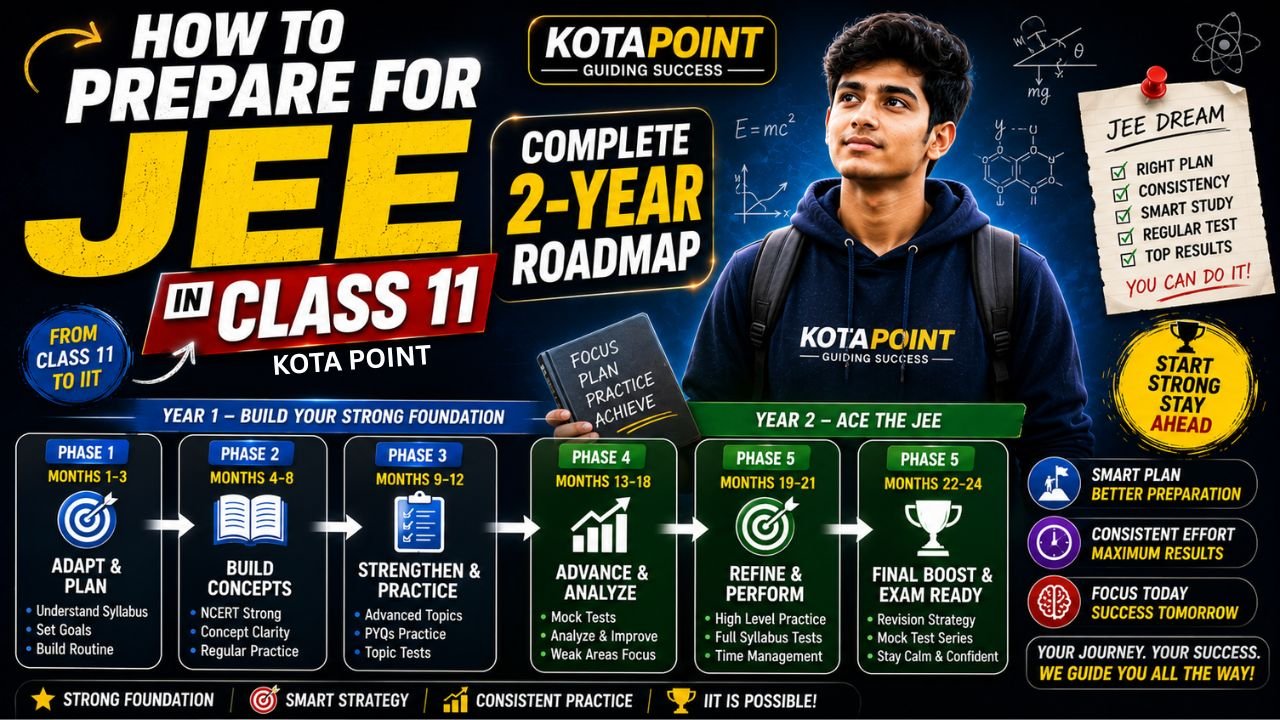
How to Prepare for JEE in Class 11 – Complete 2-Year Roadmap
Starting JEE prep in Class 11 gives you a massive edge. This guide breaks down exactly what to study, when to study it, and how to stay ahead — straight from Kota’s top educators.
Class 11 is the most underrated year in a JEE aspirant’s journey. Most students treat it casually — attending school, covering basics — and then panic in Class 12. The students who crack JEE Advanced with top ranks almost always started their serious preparation in Class 11.
This guide gives you a complete, realistic 2-year roadmap — month by month — to prepare for both JEE Main and JEE Advanced starting from Class 11.
Students who have just entered or are about to enter Class 11 and want to crack JEE Main (top 99 percentile) or JEE Advanced. Works whether you’re joining Kota coaching or self-studying.
Why Class 11 is the Real Foundation
JEE Advanced tests your conceptual depth — not just formula memorisation. Nearly 45–50% of JEE questions are rooted in Class 11 topics. If you rush through Class 11 to “catch up” in Class 12, you’ll end up with weak foundations in:
- Mechanics & Kinematics (Physics)
- Organic Chemistry basics (Nomenclature, GOC, Reactions)
- Trigonometry, Sets, Relations & Functions (Maths)
These topics appear directly or indirectly in almost every JEE paper. Skipping them means losing easy marks AND losing the ability to attempt harder questions that build on them.
Many students focus only on Class 12 boards and neglect Class 11 JEE syllabus. In JEE Main 2024, over 40% questions were from Class 11 topics alone. Don’t make this mistake.
The Complete 2-Year Roadmap
Here is a phase-wise breakdown of the two-year journey from Class 11 Day 1 to JEE Advanced:
Class 11 Monthly Study Plan
This is the most important section for freshers. Follow this month-by-month breakdown in your first year:
| Month | Physics | Chemistry | Mathematics |
|---|---|---|---|
| Apr–May Foundation |
Units & Measurements, Kinematics 1D | Mole Concept, Atomic Structure | Sets, Relations, Basic Algebra |
| Jun | Kinematics 2D, Laws of Motion | Periodic Table, Chemical Bonding | Trigonometry (all formulas + equations) |
| Jul | Work, Energy & Power | States of Matter, Thermodynamics | Quadratic Equations, Progressions |
| Aug–Sep | Rotational Motion, Gravitation | Equilibrium, Redox Reactions | Straight Lines, Circles, Conic Sections |
| Oct | Properties of Matter, Oscillations | Hydrogen, s-block Elements | Permutation & Combination, Binomial |
| Nov–Dec First Mocks |
Waves, Revision of Class 11 | Organic Chem basics, GOC | Complex Numbers, Limits & Continuity |
| Jan–Mar | Full Revision + PYQ solving | Hydrocarbons, Environmental Chem | Differentiation, Application of Derivatives |
Don’t move to the next chapter until you can solve at least 70% of JEE-level problems from the current one. Rushing ahead with weak chapters is the #1 reason students plateau at 90 percentile.
Subject-Wise Strategy
Each subject in JEE demands a different approach. Here’s how to attack each one:
- Start with NCERT, then HC Verma
- Prioritise Mechanics & Electrostatics
- Solve DC Pandey for practice
- Make formula sheets weekly
- Visualise problems before solving
- NCERT is gold — read it 3x
- Organic: focus on mechanisms, not rote
- Physical: treat like Maths problems
- Inorganic: notes + daily revision
- JD Lee for Inorganic depth
- Consistency over speed early on
- Master Coordinate Geometry first
- Arihant Skills in Maths series
- Attempt variety: not just easy sums
- Daily 10–15 problems minimum
How much time to spend per subject?
In Class 11, a balanced approach works best. Aim for roughly equal time across all three subjects in Phase 1, then shift more time toward your weak subject from Phase 2 onwards. A typical daily breakdown for a serious aspirant:
- Physics: 2–2.5 hours
- Chemistry: 1.5–2 hours
- Mathematics: 2–2.5 hours
- Revision/Notes: 45 minutes
Best Books for JEE Preparation
Don’t fall into the trap of buying too many books. Finish fewer books thoroughly rather than starting many and completing none.
| Subject | Book | Author | Level |
|---|---|---|---|
| Physics | Concepts of Physics Vol 1 & 2 | HC Verma | Must Have |
| Physics | Problems in General Physics | IE Irodov | Advanced |
| Chemistry | NCERT Chemistry XI & XII | NCERT | Must Have |
| Chemistry | Concise Inorganic Chemistry | JD Lee | Advanced |
| Chemistry | Organic Chemistry | MS Chauhan | Must Have |
| Maths | Skills in Mathematics (series) | Arihant / SK Goyal | Must Have |
| Maths | Problems in Calculus of One Variable | IA Maron | Advanced |
If you’re in coaching in Kota or using a study material package, stick to that + NCERT first. Add reference books only when you’ve finished your module. Two deep sources beat five shallow ones.
Ideal Daily Routine for a JEE Aspirant
Your daily schedule will determine your success more than your intelligence. Here’s a proven structure used by toppers from Kota:
Passive reading of theory, watching too many YouTube videos without solving problems, studying without a target for the session, and skipping mock analysis — these habits waste hours without building exam-readiness.
When and How to Give Mock Tests
Mock tests are not just practice — they are the single most powerful tool to improve your JEE rank in the final stretch.
When to start mocks?
Begin chapter-wise tests immediately. Start full-length mocks by November of Class 11. Don’t wait until Class 12 to start attempting full papers — you’ll lose a critical feedback loop.
How to analyse a mock test?
- Categorise wrong answers: Silly mistake vs Concept gap vs Never studied
- Maintain an error log — review it weekly
- Check time distribution per section — were you spending too long in one area?
- Re-attempt wrong questions 48 hours later without looking at solutions
In the 3 months before JEE Main, aim for at least 2 full mocks per week. Many Kota toppers gave 50–70 full-length mocks in the year before their exam. Quality of analysis matters more than quantity of tests.
Transitioning to Class 12 Without Losing Momentum
The Class 11 to Class 12 transition is where many students stumble. New topics pile up, boards pressure starts, and Class 11 concepts begin to fade. Here’s how to manage it:
- Weekly revision of Class 11 topics — even 45 minutes per subject per week is enough to retain.
- Start Class 12 with integration topics (Electrostatics, Electrochemistry, Integration) — these are high-weight JEE topics.
- Boards and JEE are not enemies — 80% of boards syllabus overlaps with JEE. Scoring well in boards validates your JEE concepts.
- Don’t panic if Class 12 topics feel harder initially — everyone feels this. It normalises by October.


Leave a Reply