
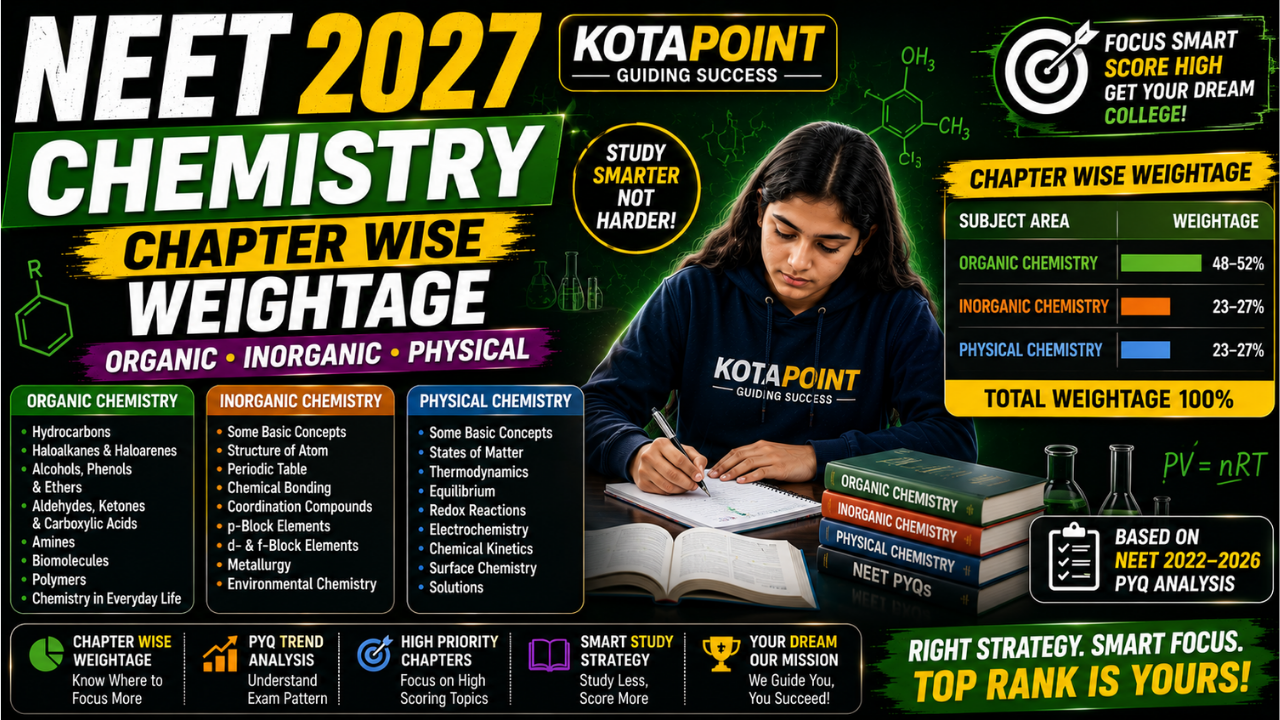
NEET 2027 Chemistry Chapter Wise Weightage

NEET 2027 Chemistry Chapter Wise Weightage Organic • Inorganic • Physical

NEET 2027 Chemistry Chapter Wise Weightage | Organic vs Inorganic vs Physical | KotaPoint.in
🧪 Chemistry Focus 📊 26 Chapters • 180 Marks 🔥 Top Chapters = 60%+ Marks ✅ June 2026 Updated

NEET 2027 Chemistry Chapter Wise Weightage
Organic • Inorganic • Physical

Complete division-wise weightage for Physical, Inorganic & Organic Chemistry. 9 high-priority chapters that deliver 60%+ marks, expected questions, interactive MCQ quiz, checklist tracker, and smart preparation strategy for each division.

26
Total Chapters
9
High Priority
60%+
From Top Chapters
180
Chemistry Marks
NMC Revised Syllabus — Valid for NEET 2025, 2026 & 2027 • Several Topics Reduced

🧪Why Chemistry Chapter Weightage Matters for NEET 2027

Chemistry carries 180 marks (25% of total). It is often considered the most balanced subject — a mix of memory (Inorganic), concept + application (Physical), and mechanism (Organic). Smart students who understand weightage can easily score 150+ marks with focused effort.

Typical Division Split in Recent NEET:
Physical Chemistry: 35–40% of Chemistry questions (numerical + concept heavy)
Organic Chemistry: 30–35% (mechanism + named reactions)
Inorganic Chemistry: 25–30% (mostly direct from NCERT)

Just like Physics, a small number of chapters dominate the paper. The top 9 chapters usually contribute 60%+ of all Chemistry questions. Focusing here gives the highest ROI on your study time.

📋NEET 2027 Chemistry Exam Pattern

50
Total Questions
45
Questions to Attempt
180
Maximum Marks
+4 / −1
Marking Scheme
3h 20m
Total Duration
OMR
Offline Mode
Section B Tip: In Chemistry Section B (15 questions), attempt only 10. Prioritize questions from high-weightage chapters like Coordination Compounds, Aldehydes/Ketones, P-Block, and Equilibrium.

🗑️Deleted / Reduced Topics in Chemistry (NMC 2023)

These topics have been reduced or removed and will have very low or zero weightage in NEET 2027.

Key Reductions:
• Environmental Chemistry — many industrial processes removed
• Chemistry in Everyday Life — partial reduction
• Surface Chemistry — detailed industrial processes reduced
• Haloalkanes & Haloarenes — some named reactions reduced
• General Principles of Metallurgy — some extraction processes removed
• Nuclear chemistry sub-topics (radioactive decay series) reduced
Action: Focus on the core remaining topics. NCERT is still your primary source for Inorganic Chemistry.

📊Complete Chemistry Chapter-wise Weightage (NEET 2027)

High Priority (≥7%) Medium Priority (4–6%) Low Priority (1–3%)
# Chapter Division Key Topics Weightage Exp. Qs Priority

* Expected questions for ~45 attempted questions. Data based on NEET 2019–2025 analysis + NMC syllabus.

🔥9 High Priority Chapters — The 60%+ Game Changers

These 9 chapters consistently deliver the majority of Chemistry questions. Master them for maximum score.

Interactive High-Priority Chemistry Checklist

Track your progress on the most important chapters. See your coverage % update live.

🎯 Your Chemistry High Priority Progress

0%
Weightage Covered
Readiness Level

🧪Test Yourself — Interactive Chemistry MCQ Quiz

9 NEET-level questions balanced across Physical, Inorganic & Organic. Recommended time: 12–15 minutes. Detailed explanations after submission.

🧪 Chemistry Weightage Quiz
Question 1 of 9
Pro Tip: After this quiz, solve chapter-wise PYQs from the 9 high priority chapters. Focus especially on Coordination Compounds, Aldehydes/Ketones, and P-Block.

📅Division-wise Strategy & Recommended Time Split

⚗️
Physical Chemistry (35–40% time)
Daily numerical practice is non-negotiable. Master mole concept, equilibrium, electrochemistry & kinetics first. Use N. Avasthi or similar for problems. Make formula sheets for quick revision.
⚛️
Inorganic Chemistry (25–30% time)
NCERT is everything. Read every line, every table, every exception. Make short notes for trends, compounds & reactions. P-Block + Coordination + D&F Block are highest yield.
🧬
Organic Chemistry (30–35% time)
Focus on GOC first, then named reactions & mechanisms. Practice conversion problems daily. MS Chauhan or similar for mechanism questions. Revise reactions every week.
Recommended Daily Split (for serious aspirants): 2 hrs Physical (numericals) + 1.5 hrs Organic (reactions + mechanisms) + 1 hr Inorganic (NCERT reading + notes). Adjust based on your weak areas.

📚Best Books for NEET Chemistry 2027

Golden Rule: Complete NCERT Chemistry (Class 11 + 12) at least 3 times. It is sufficient for 70–75% of Inorganic questions and forms the base for Organic & Physical. Use reference books only for extra practice.

💡Topper Tips for Scoring 150+ in Chemistry

1
NCERT is Non-Negotiable for Inorganic
Most Inorganic questions come directly from NCERT text, tables or examples. Read every single line. Make a separate notebook for exceptions and trends.
2
Named Reactions = Organic Score Booster
Master all important named reactions (Aldol, Cannizzaro, Wolff-Kishner, Hoffman, etc.) with mechanisms. They appear repeatedly in different forms.
3
Physical = Consistency Over Intensity
Solve 8–10 numericals daily from high weightage chapters. Consistency beats marathon sessions. Review mistakes the same day.

Frequently Asked Questions — NEET 2027 Chemistry Weightage