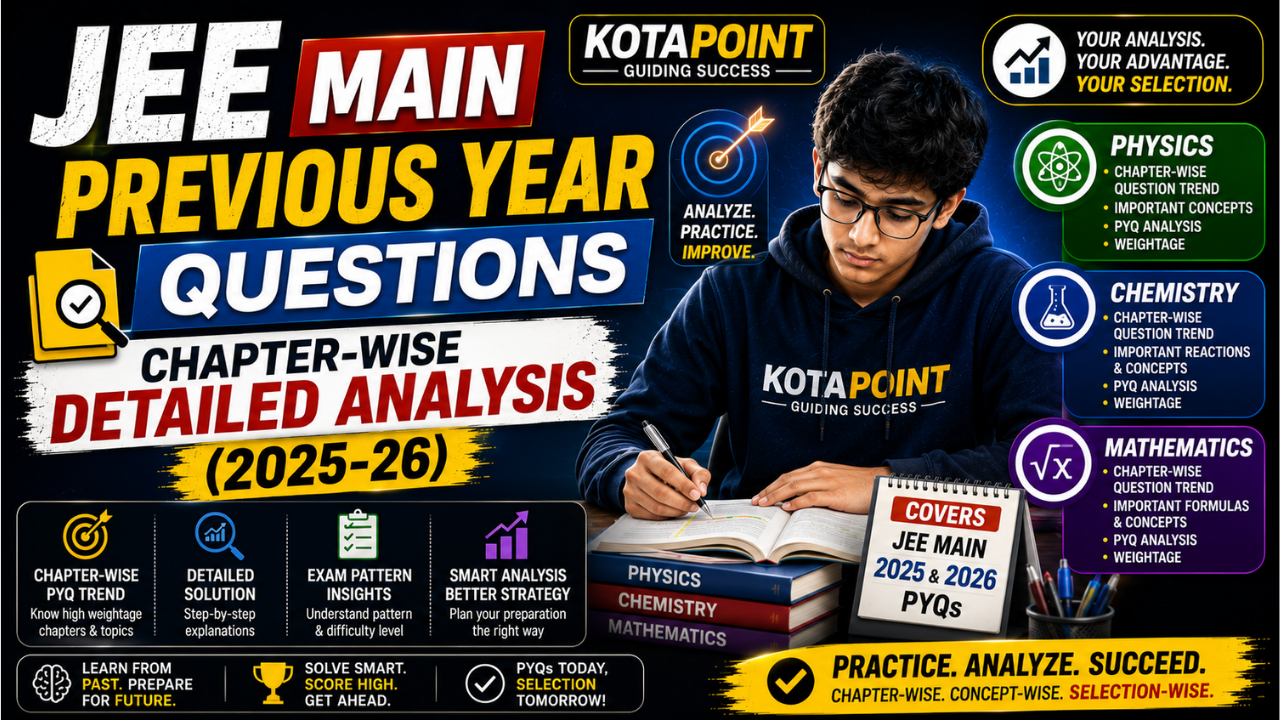

JEE Main Previous Year Questions — Chapter-wise Detailed Analysis (2025-26)
Complete chapter-wise breakdown of JEE Main PYQs (2019–2025) for Physics, Chemistry & Mathematics. Includes high-weightage chapters, MCQ vs Numerical trends, difficulty analysis, recurring concepts, best PYQ books, subject-wise strategy and 15 expert FAQs — everything you need to master PYQ-based preparation for JEE Main 2027.
⚡What is JEE Main PYQ Chapter-wise Analysis?
JEE Main Previous Year Questions (PYQs) are the single most reliable source for understanding NTA’s question-setting pattern, difficulty level, and topic priorities. This comprehensive chapter-wise analysis covers all official JEE Main papers from 2019 to 2025 (both January & April sessions) — more than 300 shifts and approximately 22,500+ questions.
Whether you are a Class 11 student starting early, a Class 12 student in full swing, or a dropper aiming for 99+ percentile in JEE Main 2027, this data-driven guide will help you allocate study time intelligently across Physics (~22 chapters), Chemistry (~26 chapters) and Mathematics (~25 chapters).
📋JEE Main 2026-27 Exam Pattern & Marking Scheme
| Subject | Section A (MCQs) | Section B (Numerical) | Total Qs | Total Marks |
|---|---|---|---|---|
| Physics | 20 MCQs | 5 Numerical | 25 | 100 |
| Chemistry | 20 MCQs | 5 Numerical | 25 | 100 |
| Mathematics | 20 MCQs | 5 Numerical | 25 | 100 |
| Grand Total | 60 | 15 | 75 | 300 |
📈Key PYQ Trends & Changes (2019-2025)
Analysis of official NTA papers reveals clear patterns that every serious aspirant must know:
- Electrostatics & Current Electricity consistently contribute 15-18% combined
- Ray Optics & Wave Optics together ~10-12% every year
- Modern Physics (Dual Nature + Atoms + Nuclei) stable at 8-10%
- Thermodynamics + KTG now more conceptual numericals
- Mechanics (especially Rotational) remains high weightage but questions are trickier
- Experimental skills / graph-based questions increased post-2023
- Coordination Compounds — highest single chapter weightage (~8-9%)
- Organic Chemistry (especially Aldehydes/Ketones/Acids) ~18-20% of Chemistry
- p-Block Elements (Groups 15-18) very consistent every session
- Physical Chemistry numericals have become lengthier but scoring
- Inorganic Chemistry questions are more NCERT-direct in recent years
- Biomolecules & Polymers reduced but still appear as easy 1-2 markers
- Calculus (Limits, Derivatives, Integrals, Differential Equations) dominates with ~22-25% weightage
- 3D Geometry + Vectors together a consistent 10-12% (easy to moderate difficulty)
- Matrices & Determinants + Probability are high-yield short chapters
- Coordinate Geometry (Circles, Parabola, Ellipse, Hyperbola) still very important
- Algebra (Complex Numbers, Quadratic, Sequences) appears in almost every paper
- Trigonometry weightage has slightly decreased but remains scoring
📖Chapter-wise PYQ Weightage Analysis (2019-2025)
| # | Chapter | Key PYQ Concepts & Trends | Weightage | Priority |
|---|
| # | Chapter | Key PYQ Concepts & Trends | Weightage | Priority |
|---|
| # | Chapter | Key PYQ Concepts & Trends | Weightage | Priority |
|---|
📝Featured Previous Year Questions from High Weightage Chapters (2023-2025)
Here are real-pattern questions from recent JEE Main papers. These represent the style and difficulty level you can expect from high-weightage chapters. Practice similar questions from the official papers.
Explanation: By Gauss’s law, flux = Q_enclosed / ε₀. It depends only on the charge enclosed, not on the size of the Gaussian surface. Hence flux remains the same.
Explanation: Using Kirchhoff’s laws or current division, the value of X comes out to be 5Ω for the given current of 2A through 5Ω resistor.
Explanation: F⁻ is a weak field ligand, so Δ₀ for [CoF₆]³⁻ is much smaller (~40% of NH₃ complex). 22,000 × 0.4 ≈ 8,800 cm⁻¹.
Ph-CHO + CH₃CH₂MgBr → ? (followed by H₃O⁺)
Explanation: Grignard reagent adds to carbonyl carbon of benzaldehyde giving secondary alcohol after hydrolysis.
Explanation: This is a standard definite integral solved using substitution x = 1/t and property of definite integrals. The exact value leads to the given expression.
r = (î + ĵ – k̂) + λ(2î – ĵ + k̂) and
r = (2î – ĵ – k̂) + μ(î + 2ĵ – 3k̂) is:
Explanation: Use the formula for shortest distance between two skew lines. After calculation, the distance comes out to be 1/√6 units.
📚Extensive PYQ Practice Bank — High Weightage Chapters
Below is a curated collection of 20–25 representative PYQs per subject from high and medium weightage chapters (primarily 2022–2025). Click on any chapter to expand and practice. These follow the exact style and difficulty of actual JEE Main questions.
Electrostatics (3 Questions)
Current Electricity (3 Questions)
Ray Optics (3 Questions)
Thermodynamics (3 Questions)
Rotational Motion (2 Questions)
Electromagnetic Induction & AC (3 Questions)
Modern Physics (Atoms + Nuclei) (3 Questions)
Coordination Compounds (4 Questions)
Aldehydes, Ketones & Carboxylic Acids (3 Questions)
p-Block Elements (15-18) (3 Questions)
Electrochemistry (3 Questions)
Chemical Kinetics & Equilibrium (3 Questions)
Chemical Bonding (3 Questions)
d & f Block + Metallurgy (3 Questions)
Definite Integration (4 Questions)
3D Geometry + Vectors (3 Questions)
Matrices & Determinants (3 Questions)
Coordinate Geometry (Circles) (3 Questions)
Probability + Permutations (3 Questions)
Complex Numbers + Quadratic (3 Questions)
Sequences, Series & Binomial (3 Questions)
🔥Top 15 Highest Weightage Chapters Across All Subjects
These 15 chapters together contribute approximately 55-60% of the total questions in JEE Main. Prioritize them in your first round of revision.
| Rank | Chapter | Subject | Avg. Weightage | Recommended PYQ Focus |
|---|---|---|---|---|
| 1 | Electrostatics | Physics | ~8.5% | Gauss law, Potential, Capacitance |
| 2 | Current Electricity | Physics | ~8.0% | Kirchhoff, Wheatstone, Potentiometer |
| 3 | Coordination Compounds | Chemistry | ~8.0% | CFT, Isomerism, Nomenclature |
| 4 | Calculus (Integration) | Mathematics | ~7.5% | Definite integrals, Area, Properties |
| 5 | Ray Optics | Physics | ~7.5% | Mirrors, Lenses, Prism, Optical instruments |
| 6 | Aldehydes, Ketones & Carboxylic Acids | Chemistry | ~7.0% | Named reactions, Mechanisms, Acidity |
| 7 | Thermodynamics | Physics | ~6.5% | First law, Carnot, Entropy |
| 8 | 3D Geometry | Mathematics | ~6.5% | Lines, Planes, Shortest distance |
| 9 | Rotational Motion | Physics | ~6.0% | MI, Torque, Rolling, Angular momentum |
| 10 | p-Block Elements (15-18) | Chemistry | ~6.0% | Trends, Compounds, Reactions |
| 11 | Matrices & Determinants | Mathematics | ~5.5% | Adjoint, Inverse, System of equations |
| 12 | Electrochemistry | Chemistry | ~5.5% | Nernst, Conductance, Batteries |
| 13 | Work, Energy & Power + Rotational | Physics | ~5.5% | Collisions, Potential energy |
| 14 | Coordinate Geometry (Circles) | Mathematics | ~5.0% | Equation, Tangent, Chord of contact |
| 15 | Chemical Kinetics + Equilibrium | Chemistry | ~5.0% | Rate laws, Le Chatelier, Kp/Kc |