
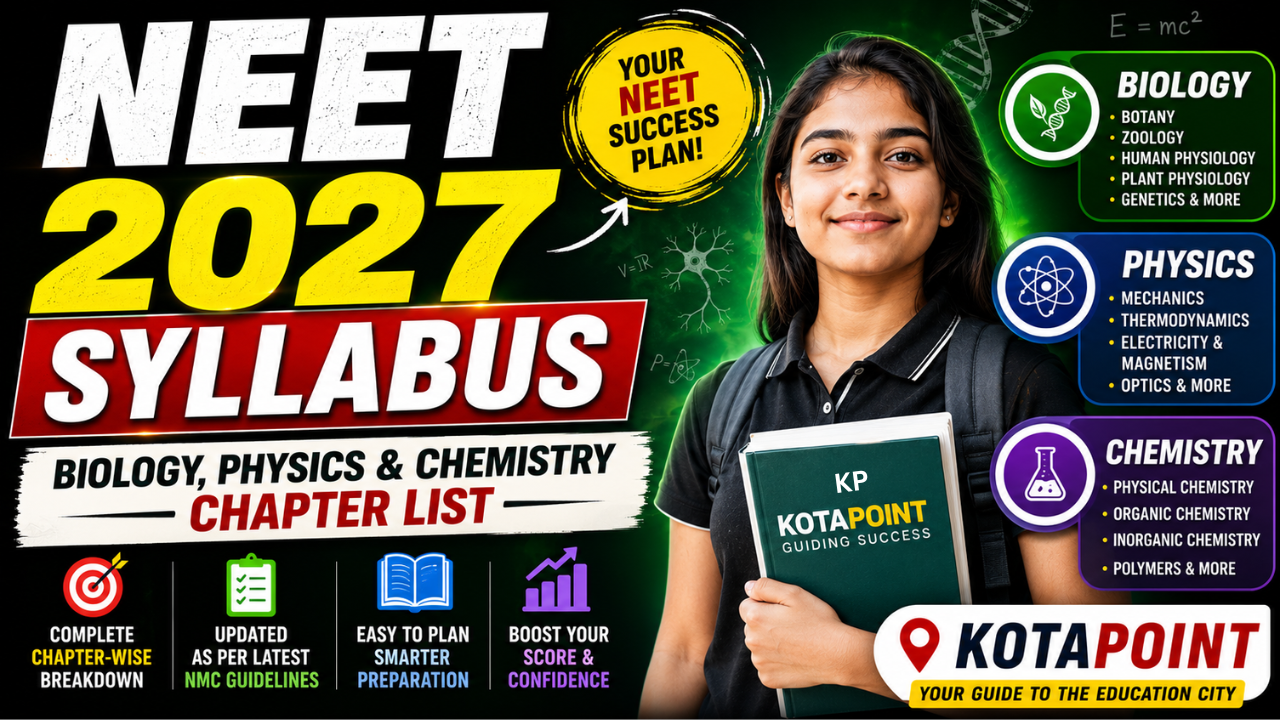

NEET 2027 Ultimate Guide: Syllabus, Weightage & Topper Roadmap
Your complete blueprint to scoring 680+ in NEET UG 2027. Master the official 79-chapter NMC syllabus, discover exact chapter weightage, and decode the strategies used by toppers.
Table of Contents
1. NEET 2027 Chapter-Wise Weightage Analysis
You cannot study everything with equal intensity. Based on previous years’ NTA question patterns, specific chapters yield heavily disproportionate returns. Prioritize the high-weightage zones shaded in red below.
Biology Weightage (Botany & Zoology)
Biology accounts for exactly 50% of the NEET exam (360 marks). 95-100% of questions map directly to the NCERT.
| Chapter Group / Unit | Avg. Questions | Weightage % |
|---|---|---|
| Human Physiology (Class 11) | 14 – 15 | 18% – 20% |
| Genetics & Evolution (Class 12) | 15 – 16 | 18% |
| Ecology & Environment (Class 12) | 10 – 12 | 15% |
| Cell Structure & Function | 7 – 8 | 10% |
| Plant Physiology | 7 – 8 | 10% |
| Biotechnology & Its Applications | 8 – 9 | 10% |
| Diversity in Living World | 6 – 8 | 8% |
| Human Health & Disease | 3 – 4 | 5% |
Physics Weightage
Physics tests your conceptual speed. Mechanics and Electrodynamics make or break your score.
| Chapter Group / Unit | Avg. Questions | Weightage % |
|---|---|---|
| Current Electricity | 4 – 5 | 9% |
| Thermodynamics & KTG | 4 – 5 | 8% |
| Modern Physics (Atoms, Nuclei, Dual Nature) | 6 – 7 | 12% |
| Electrostatics & Capacitance | 3 – 4 | 7% |
| Laws of Motion & Rotational Mechanics | 5 – 6 | 10% |
| Ray & Wave Optics | 4 – 5 | 9% |
| Semiconductor Electronics | 3 | 6% |
| Magnetic Effects of Current | 3 | 6% |
Chemistry Weightage
Organic Chemistry is highly rewarding. Learning named reactions properly fetches easy marks every year.
| Chapter Group / Unit | Avg. Questions | Weightage % |
|---|---|---|
| Aldehydes, Ketones & Carboxylic Acids | 3 – 4 | 9% |
| Chemical Bonding & Molecular Structure | 3 – 4 | 8% |
| Coordination Compounds | 3 | 7% |
| Basic Principles of Organic Chemistry | 3 | 7% |
| Equilibrium & Chemical Kinetics | 4 – 5 | 10% |
| Hydrocarbons | 2 – 3 | 6% |
| d & f Block Elements | 2 | 4% |
| Practical Chemistry (Experimental) | 2 | 4% – 5% |
2. Updated NEET 2027 Syllabus (79 Chapters)
Following the rationalization by the National Medical Commission (NMC), the NEET syllabus has been trimmed from 97 chapters down to 79 chapters to match the new NCERT books. Do not waste time on deleted topics (like Digestion & Absorption or Solid State).
Biology (Class 11 & 12)
- Diversity in Living World
- Structural Organisation in Animals and Plants
- Cell Structure and Function
- Plant Physiology
- Human Physiology
- Reproduction
- Genetics and Evolution
- Biology and Human Welfare
- Biotechnology and Its Applications
- Ecology and Environment
Physics (Class 11 & 12)
- Physics and Measurements
- Kinematics & Laws of Motion
- Work, Energy, and Power
- Rotational Motion & Gravitation
- Properties of Solids and Liquids
- Thermodynamics & KTG
- Oscillations and Waves
- Electrostatics & Current Electricity
- Magnetic Effects & EMI
- Optics & Modern Physics
- Electronic Devices
- Experimental Skills
Chemistry (Physical, Organic, Inorganic)
- Basic Concepts & Atomic Structure
- Chemical Bonding & Thermodynamics
- Solutions & Equilibrium
- Redox & Chemical Kinetics
- Classification of Elements & Periodicity
- p-Block, d-Block, and f-Block Elements
- Coordination Compounds
- Hydrocarbons & Haloalkanes
- Oxygen & Nitrogen Containing Compounds
- Biomolecules
- Principles of Practical Chemistry
3. Best Books for NEET 2027 Preparation
Toppers are unanimous: Too many books cause confusion. Stick to a compact, high-quality set of resources.
- The Bible: NCERT Class 11 & 12 Books for Physics, Chemistry, and Biology (Absolute priority).
- Biology Practice: MTG Objective NCERT at your Fingertips (Best for line-by-line NCERT extraction).
- Physics Concepts: Concepts of Physics by H.C. Verma (Volume 1 & 2) – Excellent for understanding logic before doing MCQs.
- Physics Practice: D.C. Pandey Objective Physics for NEET.
- Organic Chemistry: M.S. Chouhan (For advanced mechanism practice) or standard MTG Fingertips.
- Physical Chemistry: N. Awasthi (Great for numerical problem-solving).
- Past Papers: 36 Years Chapter-wise PYQs (Previous Year Questions) by MTG or Arihant.
4. Toppers’ 6-Month Roadmap & Strategy
A staggering 90% of a topper’s success lies in execution, not intelligence. Here is the blueprint used by high achievers to secure top medical colleges.
The 3-Phase Blueprint
- Phase 1: Concept Build (Months 1-3)
Focus on line-by-line reading of NCERT. Make your own one-page revision sheets. Do not rely on printed notes from coaching institutes; writing it yourself builds memory. - Phase 2: Intensify (Months 4-5)
Heavy practice. Shift to topic-wise and subject-wise mock tests. Focus intensely on creating a “Mistake Log” (Error Journal) where you write down every question you get wrong and why. - Phase 3: Consolidate (Last 30 Days)
Attempt 2-3 full-length (180 mins) mock tests per week exactly between 2 PM to 5:20 PM to train your biological clock. Stop learning new topics; revise flashcards only.
Daily Micro-Schedule of a Topper
Toppers do not believe in studying 15 hours a day. They study in focused bursts (Pomodoro technique):
- Morning (2.5 hrs): Deep reading of new theory (Biology/Inorganic Chemistry).
- Afternoon (3 hrs): Heavy numerical practice (Physics/Physical Chemistry). Treat problems as puzzles, not chores.
- Evening (2 hrs): Active recall, flashcards, and reviewing the mistake log.
- Night: Proper 7-8 hours of sleep. Memory consolidation happens during sleep.
5. Frequently Asked Questions (FAQs)
Have doubts about your NEET 2027 preparation? Here are the most commonly asked questions answered by our experts.
Yes, the NEET 2027 syllabus follows the rationalized NCERT structure updated by the National Medical Commission (NMC). It currently consists of 79 chapters across Physics, Chemistry, and Biology, replacing the older 97-chapter structure.
Biology (Botany and Zoology) carries the highest weightage, accounting for 50% of the exam (90 questions, 360 marks). Physics and Chemistry each account for 25% (45 questions, 180 marks each).
Based on recent trends, Human Physiology (18-20%), Genetics & Evolution (18%), Ecology (15%), and Biotechnology (8-10%) hold the highest weightage in Biology. Genetics alone can yield up to 10-12 questions.
Yes, experimental skills have been explicitly added to both Physics and Practical Chemistry sections by the NMC. Students must familiarize themselves with standard laboratory procedures, Vernier calipers, screw gauge, and salt analysis.
Toppers recommend 6 to 8 hours of focused, highly concentrated study daily, alongside proper 7-8 hours of sleep. Quality, active recall, and consistency matter far more than passive 15-hour marathon reading sessions.
NCERT is the supreme resource. For practice, use MTG Objective NCERT at your Fingertips. For Physics concepts, HC Verma is great. For Chemistry practice, MS Chouhan for Organic and N Awasthi for Physical are highly recommended.
For Biology and Inorganic Chemistry, NCERT is 100% sufficient as almost all questions are directly derived from the text and diagrams. For Physics and Physical Chemistry, NCERT is essential for theory, but you will need supplementary material for extensive numerical practice.
A proven strategy used by toppers is to finish Biology in 45-50 minutes, Chemistry in 50 minutes, leaving about 1 hour and 15 minutes for Physics. The remaining time is utilized for careful OMR bubbling and reviewing flagged difficult questions.
Yes, the NEET exam paper maintains a remarkably consistent balance, splitting the questions approximately 50-50 between the Class 11 (Plus One) and Class 12 (Plus Two) syllabus across all three subjects.
The most fatal mistakes include: ignoring NCERT to read complex reference books, taking mock tests but failing to analyze the mistakes afterward, skipping “hard” chapters entirely, and sacrificing sleep which destroys memory retention.